
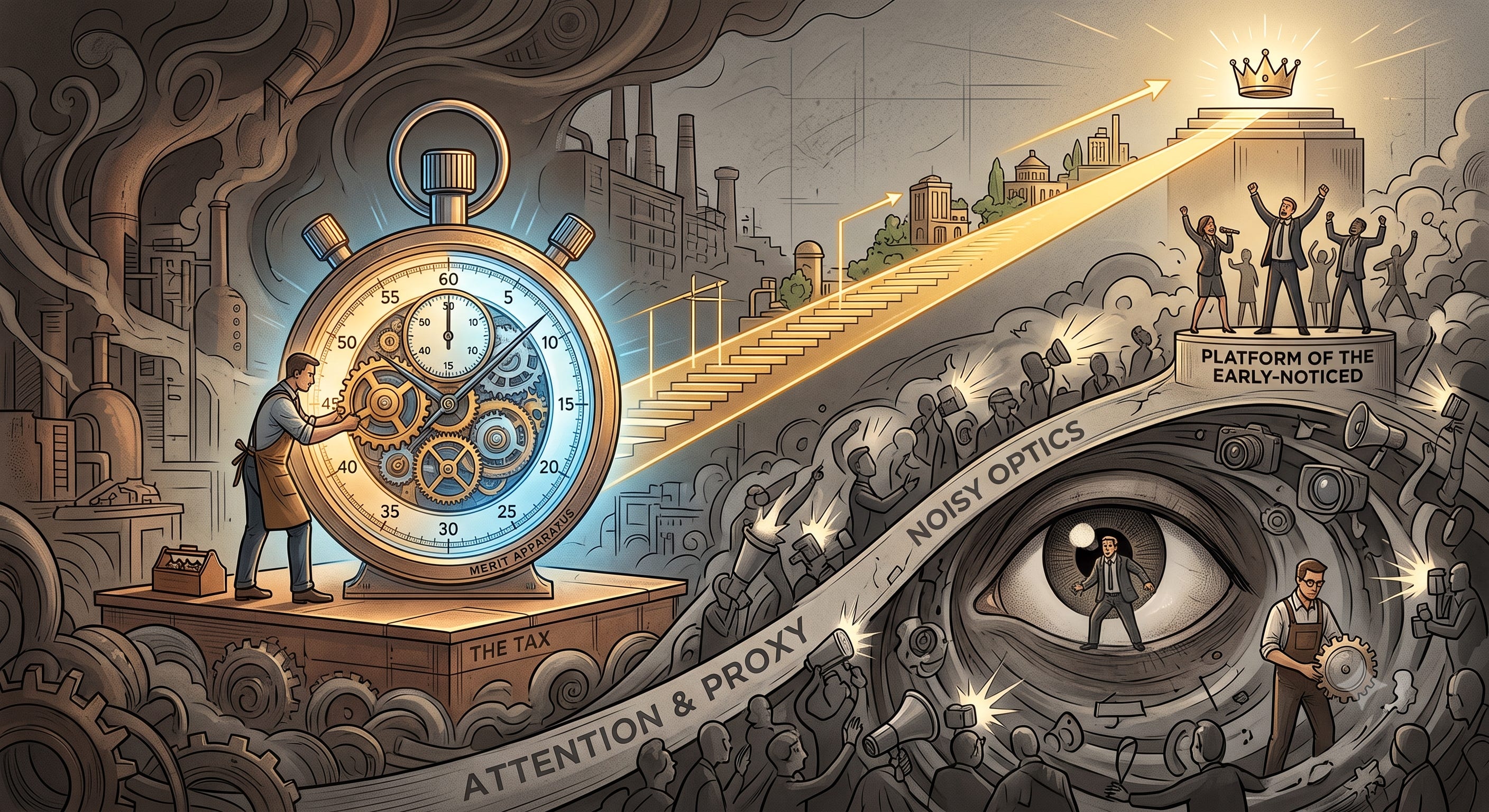
Three essays is enough diagnosis.
The first said order is expensive and must be paid for. The second said the thing that notices you is half-blind. The third said whether you are seen at all turns on machinery outside your control. All three looked at the system from outside — at fields, at sensors, at the cold architecture of recognition.
But you are not a field. You are a person who builds. So let the last word be to you, and not about the machine.
The question the diagnosis leaves
If the clock is this unreliable — slow, coarse, sometimes impossible — then a quiet corrosion sets in. Why build well, when building well is not what the clock rewards? Why hold a standard the sensor cannot read? The logic of all three essays seems to end in a shrug.
There is a comfortable answer, and it should be refused. The comfortable answer says recognition does not matter — do the work for its own sake and be at peace. This is a lie told to the unseen to keep them quiet. Recognition matters. It buys the room to keep building; withheld long enough, it starves the work out entirely. Anyone who tells you the makers do not need to be seen has never been the one going unseen.
So the turn is not away from wanting recognition. It is harder than that.
What the verdict cannot reach
Here is the thing the three essays were circling. A reason you do not control is not a reason you can live on.
If the clock is your reason for building, you have handed your persistence to an instrument that may never turn your way — and if it does turn, may turn for reasons that have nothing to do with your work. That is not humility. It is a kind of captivity, and it ends the same way for the deserving and the undeserving: with the work abandoned the moment the verdict comes back wrong.
There is another place to stand. Not instead of wanting to be seen — underneath it. Anchor to the part of the work the verdict cannot reach. The quality of the thing when no one is watching. The standard you keep when keeping it costs you. The person on the other end the work was for. None of these does the clock pay. None of these can the clock revoke. Build from there, and you become, in one exact sense, unkillable — not unrewarded, but no longer at the mercy of whether the reward arrives.
The makers who already know this
Look, one last time, at the ones who keep the clocks honest.
The reviewer who reads the paper closely when a glance would do. The auditor who holds the standard on a file no one will ever open. The keeper of a measure that lets everyone else be judged fairly, and is never judged fairly in return. These are the least-seen makers there are — the ones whose whole craft is to vanish when it works.
They are not the casualties of this story. They are its answer. They do the work for something the clock was never able to see, and the clock’s blindness does not stop them. Whatever they anchor to, it is not the verdict. It cannot be. No verdict ever comes.
Be that kind of maker. Not because it is noble to go unseen — it is not, and you are allowed to want more. But because they have already found the one ground that does not move.
You will be measured by a clock you did not build and have every reason not to trust.
Let it measure.
Build as though the work were worth it — because whether or not the clock ever agrees, that is the single verdict still yours to give.
And it was always the only one that was ever yours.
Organizational Systems — a four-part series: Part 1: The Makers Are Not Naive · Part 2: The Makers Nobody Noticed · Part 3: The Makers And The Stopwatch · Part 4: What Remains For The Makers (this essay — closing note)