
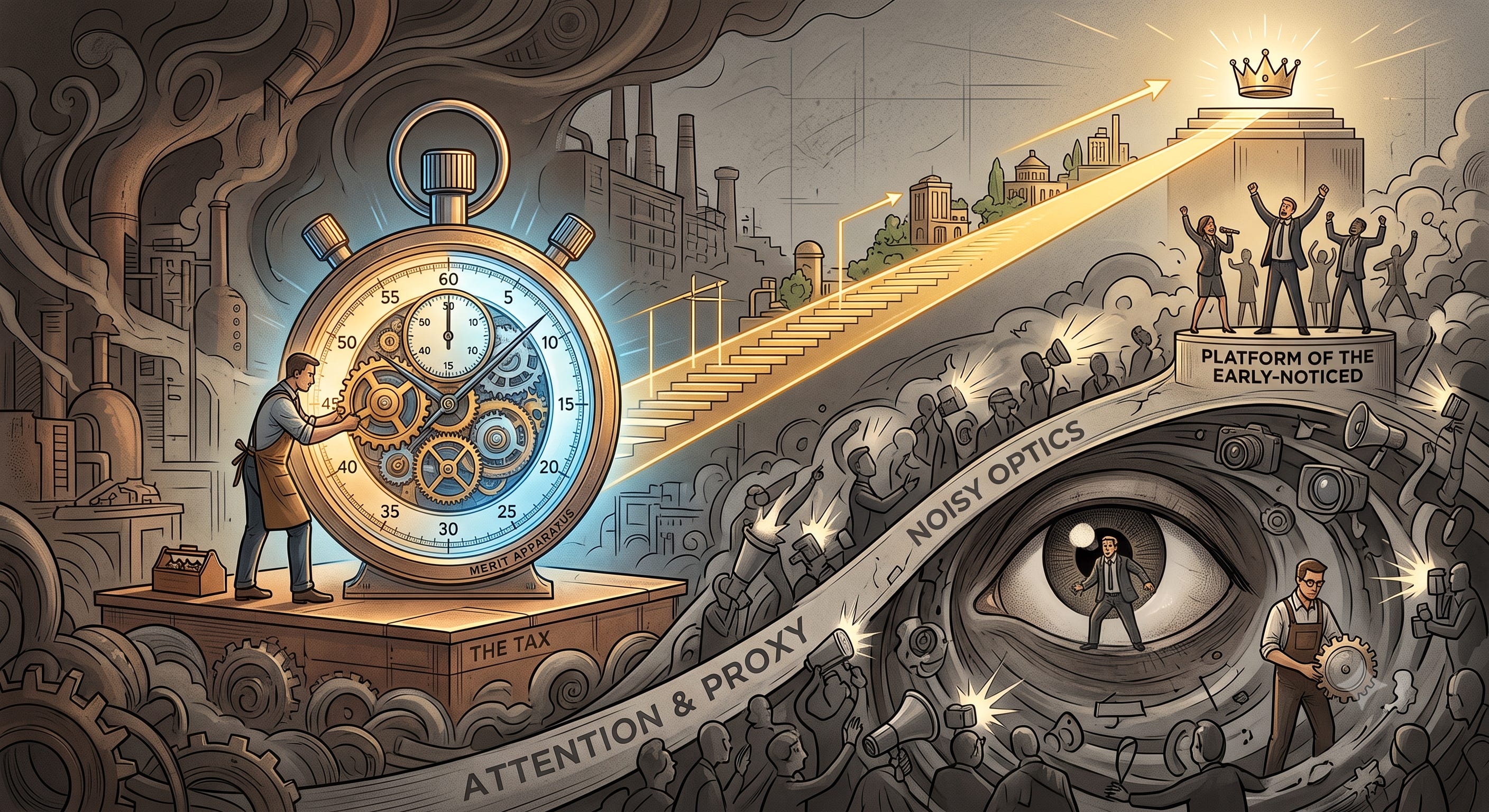
We mistake them for naive because they don’t perform. They tend to the thing itself while everyone around them tends to its reputation. But watch a company over a long enough horizon and a quieter question surfaces: what is actually holding the thing together?
A question to sit with
Ask it plainly. If your people must play politics to survive, what are they no longer spending that energy on? If perception inside your walls has become more load-bearing than truth, what happens on the day the two diverge — and they always, eventually, diverge?
The usual story casts politics as a villain that creeps in and competes with the builders. I’m no longer sure that’s the right picture. Politics may not be the opponent of order at all. It may be what disorder looks like in a human system — the shape energy takes when no one is paying to hold things in form.
Why does substance lose?
Here is the part worth slowing down for. Substance does not lose to a stronger enemy. It loses to no enemy at all.
Order is expensive. Disorder is free. A built thing — a working product, an honest culture, a true account of where you stand — is a pocket of order held against the current, and the current never stops. This is why nothing good stays built on its own. Not betrayal, not sabotage. Just the slow return to average the moment the cost of order goes unpaid.
So the builder isn’t the hero who defeats the rot. The builder is whoever keeps paying. And the bill comes again every quarter.
An honesty I owe you
I should name what’s happening as you read this. I am making a case for substance — with craft. These cadences, this turn you’re reading right now: signal, made well, working on you in real time. If I’m right that the maker who cannot speak loses to the one who can, then I can’t pretend persuasion is the enemy. Persuasion is a made thing too. The dishonesty was never the storytelling. It was telling a story with nothing underneath it.
So the cure isn’t to silence the storytellers and crown the builders. It’s narrower, and harder: stop rewarding the story that has nothing under it. Reward the people building the thing the story is about — and let them learn to speak.
What remains when the slogans go
Strip the slogan and a plainer claim is left standing. Substance over signal is not a virtue you possess. It is a tax you re-pay, or the rot returns — not because someone willed it, but because no one was holding the line that day.
The organizations that last are not the ones that chose substance once.
They are the ones still paying.
Organizational Systems — a four-part series: Part 1: The Makers Are Not Naive (this essay) · Part 2: The Makers Nobody Noticed · Part 3: The Makers And The Stopwatch · Part 4: What Remains For The Makers (closing note)