
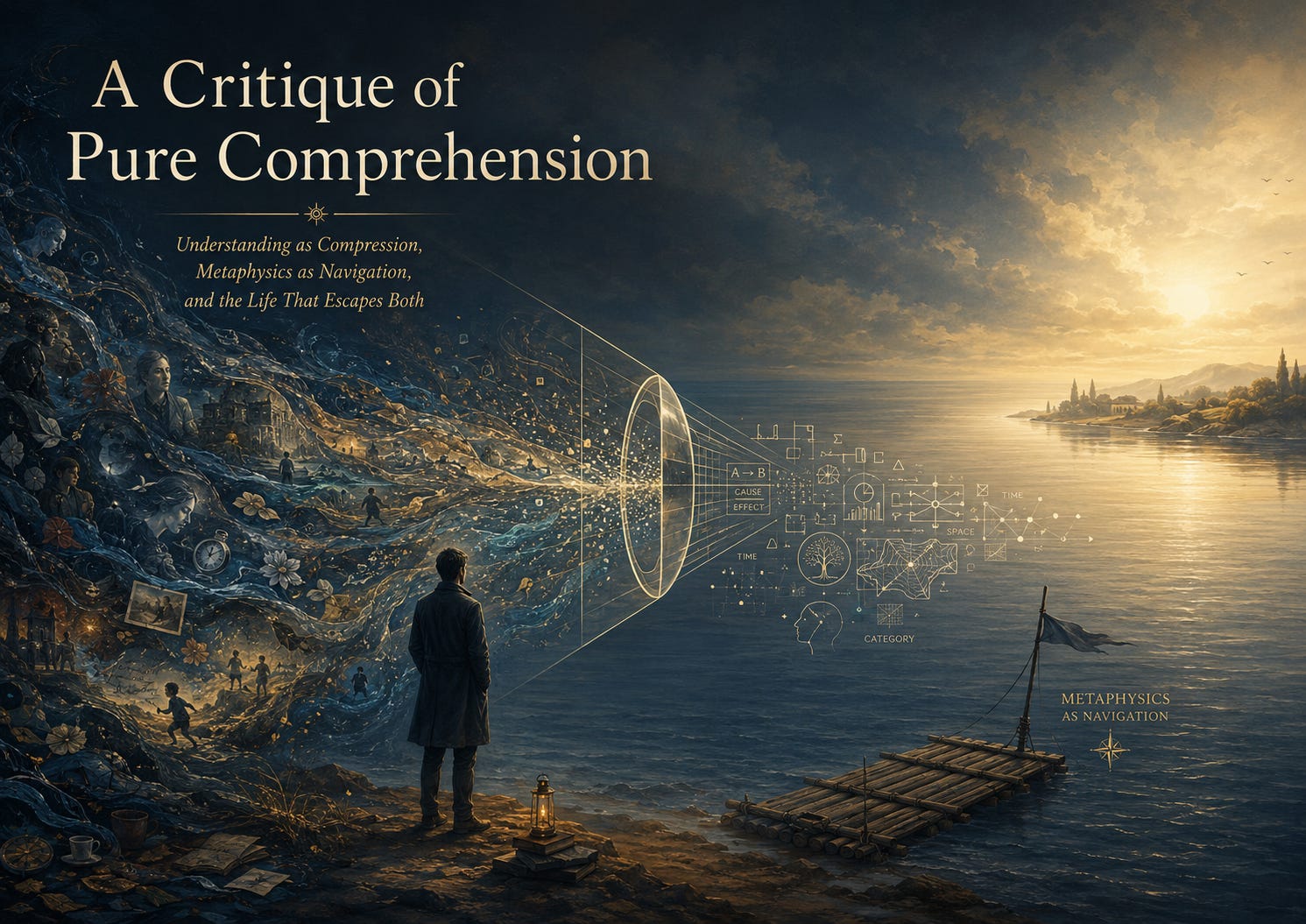
Understanding decides what must remain.
Wisdom no longer needs anything to remain.
We usually arrange cognition as a ladder.
Critique of Pure Comprehension — Part II of II
Previous in the series: Comprehension Is Compression — Part I
First comes information. Then knowledge. Then understanding. Finally, at the summit, wisdom.
Each level is assumed to contain the previous one while adding something more. Understanding is richer than knowledge; wisdom is deeper than understanding. Wisdom, on this account, is the most complete comprehension available to us.
But what if this hierarchy is wrong?
What if wisdom is not the completion of understanding, but its reversal?
What if understanding and wisdom move in opposite directions?
Understanding seeks to retain.
Wisdom lets go.
Understanding asks what must be preserved for the event to remain intelligible.
Wisdom asks why anything must be preserved at all.
The first essay in this series began with a proposition:
Comprehension is compression.
To understand an event, a person, an argument, or a life, the mind must reduce its resolution. It discards particulars and preserves relations. It converts the overwhelming abundance of experience into something portable: a cause, a pattern, a character, a lesson, a meaning.
Understanding throws much away.
But it does not throw everything away.
It preserves what it calls the signal.
This second essay begins where the first one stopped.
What happens when the signal must also go?
The Remainder
Every act of comprehension produces a remainder.
A thousand details disappear, but something survives:
This is what happened.
This is why it happened.
This is what it means.
This is what I learned.
The surviving structure may be remarkably compact. An entire childhood can be compressed into one sentence. A relationship can become a pattern. A career can become an ambition. A tragedy can become a lesson in impermanence. A life can become a philosophy.
This compression is not necessarily false.
The retained structure may be accurate. It may genuinely explain more than the details it excludes. It may help us anticipate, communicate, remember, and act.
But the structure is retained because the mind has decided that it is important.
Compression therefore always divides experience into two categories:
signal and noise.
The signal is what must remain.
The noise is what can be lost without destroying the representation.
But nothing in life announces itself as noise.
The distinction is made by the one who wishes to understand.
A doctor compresses the person into symptoms relevant to diagnosis. A historian compresses a century into events relevant to an argument. A grieving person compresses a relationship into the moments that explain its ending. A spiritual seeker compresses an entire life into the pattern of attachment and release.
Each may be justified.
Each is also selective.
Understanding is not merely the discovery of a signal already waiting inside experience. It is partly the designation of what will count as signal.
The world does not arrive divided into essence and accident.
We divide it so that we can carry it.
The Economy of Understanding
Understanding is therefore an economy.
A finite mind cannot retain the full resolution of every event. It must spend attention selectively. It must preserve what can guide future recognition and action.
This is why understanding improves memory.
The first essay put this plainly: rote memory tries to preserve the sentence; understanding preserves something closer to the grammar from which the sentence — and many other sentences — can be generated. It is worth returning to that image now, because the direction is about to reverse.
Someone who memorizes a proof can repeat it. Someone who understands it can reconstruct it, explain it differently, and apply it elsewhere. The exact sequence may be lost, but the relations remain available.
Understanding sacrifices fidelity in order to gain generativity.
It loses the original instance but preserves the capacity to produce further instances.
This is an extraordinary power.
It is also the source of a subtle confusion.
Because the representation can generate coherent explanations, we begin to mistake it for the event it represents.
The remembered lesson replaces the lived experience.
The explanation replaces the person.
The pattern replaces the relationship.
The signal replaces the world from which it was extracted.
Understanding first saves us from the abundance of life.
Then it quietly offers itself as a substitute for life.
Wisdom Is Not Better Compression
We often imagine wisdom as a superior compression algorithm.
The ordinary person sees disconnected events. The wise person sees the deeper pattern.
The ordinary person possesses fragments. The wise person possesses the whole.
The ordinary person knows many facts. The wise person has discovered the single principle that explains them all.
There is truth in this image. Wisdom is often associated with the ability to see beyond immediate appearances, recognize consequences, and distinguish what matters from what does not.
But if wisdom is fundamentally letting go, then it cannot merely be a more efficient form of retention.
A deeper explanation is still an explanation.
A final principle is still something preserved.
A perfect metaphysics is still metaphysics.
A complete understanding of life is still a representation of life.
More compression does not escape compression.
It only produces a smaller and more powerful residue.
Wisdom, in the sense explored here, begins with a second relinquishment.
Understanding lets go of the many in order to preserve the one.
Wisdom lets go of even the one that understanding preserved.
Understanding asks:
What is the invariant beneath these changing appearances?
Wisdom asks:
Why must the invariant become my possession?
Understanding reduces the world to a meaning.
Wisdom releases its demand that the world retain that meaning.
The Second Loss
The first loss makes comprehension possible.
We lose detail, ambiguity, contradiction, atmosphere, and contingency so that an intelligible structure can emerge.
The second loss makes letting go possible.
We relinquish our ownership of the structure itself.
This does not mean that the structure must be erased from memory. It does not require us to become incapable of explanation, distinction, or judgment.
The loss is more precise.
What is relinquished is the demand that the representation remain permanent, final, or identical with reality.
The wise person may still remember what happened.
But the memory is no longer required to define the event forever.
The wise person may still use a metaphysical framework.
But the framework is no longer carried as an object whose survival guarantees the survival of the self.
The wise person may still distinguish truth from error.
But even the truth is not turned into an ornament of identity.
Wisdom does not necessarily destroy understanding.
It removes understanding from the throne.
The instrument remains.
Its sovereignty ends.
Understanding and wisdom are therefore opposites in direction, but not enemies in practice.
Understanding retains a usable form.
Wisdom releases the compulsion to possess that form.
Does Wisdom Preserve Emptiness?
It is tempting to describe this reversal by saying:
Understanding throws away noise and preserves signal.
Wisdom throws away almost everything and preserves Emptiness.
But the formulation contains a final danger.
The moment Emptiness becomes something preserved, it has become the ultimate signal.
Everything else has been discarded, but one final object remains:
Emptiness is the truth.
Emptiness is what I have understood.
Emptiness is what I possess after all other possessions have disappeared.
The storage has become almost empty.
But the owner remains.
And the owner now guards Emptiness.
This is precisely why the Madhyamaka treatment of emptiness is so radical. Emptiness does not name an ultimate substance hidden behind appearances. It refers to the absence of independent, inherent nature. The theory of emptiness itself cannot consistently be treated as an independently existing, ultimately true object. Nāgārjuna’s critique is directed not only against substantial views of things, but also against the conversion of emptiness into one more view to which the mind clings.
Emptiness is therefore not the last object remaining after every other object has been removed.
It is the undoing of the demand that anything—including Emptiness—possess self-sufficient existence.
The phrase “emptiness of emptiness” protects Emptiness from becoming another fullness.
It prevents the cure from becoming the final disease.
Wisdom does not preserve Emptiness.
Wisdom lets go of the need to preserve.
Two Negations
At this point, a conceptual distinction becomes necessary.
The Upaniṣadic neti neti and the Madhyamaka emptying of views both employ negation, but they do not make identical metaphysical claims.
In the Bṛhadāraṇyaka Upaniṣad, neti neti—“not this, not this”—appears in the description of Brahman. Within Advaita Vedānta, negation is used to remove empirical attributes and mistaken identifications so that ātman may be recognized as nondual with Brahman. Advaita does not negate everything in order to affirm that nothing remains; it negates objectifiable limitations while affirming nondual consciousness as ultimate.
Madhyamaka does not arrive at this Advaitic remainder. Its critique of inherent existence extends to every phenomenon and to the conceptual status of emptiness itself. It does not replace ordinary substances with an ultimate metaphysical substance called Emptiness.
The gestures may look similar:
Not this.
Not that.
Not even the concept through which the negation was performed.
But their doctrinal commitments are not interchangeable.
Advaita’s negation can be understood as removing what the Self is not.
Madhyamaka’s negation refuses to establish any independently existing essence, including a final essence beneath negation.
The distinction matters.
Otherwise, we compress different philosophical traditions into a single comfortable doctrine of “letting go” and lose precisely the differences that make their arguments meaningful.
Our use of wisdom here is therefore not a claim that Advaita, Buddhism, and every contemplative tradition teach the same metaphysics.
It names a formal movement that can appear in different forms:
the relinquishment of attachment to the conceptual instrument.
The raft may differ.
Theories of the shore may differ.
The warning against carrying the raft can still be heard across those differences.
The Raft and the Shore
In the Alagaddūpama Sutta, the teaching is compared to a raft built for crossing, not for holding on to after the crossing has been made. The instruction is not that the raft was useless. Its usefulness is precisely why it must be used correctly.
A raft that is abandoned before entering the river cannot save anyone.
A raft carried forever after crossing becomes a burden.
This is the position of metaphysics within a critique of pure comprehension.
Metaphysics is not merely unnecessary speculation.
We already live through implicit metaphysical commitments: assumptions concerning self, permanence, causation, freedom, identity, value, and reality.
A deliberate metaphysics may expose these assumptions and reorganize attention. It may show that what appeared permanent is conditioned, that what appeared autonomous is dependent, or that what appeared to be the self was an object within awareness.
The raft is necessary because the river is real for the one trying to cross.
But the raft is still constructed.
It is made from concepts, distinctions, negations, arguments, images, and practices.
Its purpose is not to become the final property of the traveller.
Its purpose is to stop being necessary.
Understanding constructs the raft.
Wisdom knows when to release it.
The Machine That Cannot Let Go
The language model now returns as a revealing analogy.
A transformer-based language model processes contextual relations through learned parameters and attention mechanisms, then generates a sequence by repeatedly producing continuations. Its remarkable capacity arises partly from preserving distributed patterns that can be recombined in new contexts.
It does not ordinarily retrieve a complete sentence from an internal archive.
It generates another instance from what training has made available.
In that sense, it dramatizes the first half of our argument:
comprehension as generative compression.
The model preserves enough relational structure to continue.
It discards the original contexts in which countless patterns appeared, while retaining dispositions that allow related forms to be regenerated.
But the machine analogy also reveals the limit.
A language model can generate the language of renunciation.
It can describe silence.
It can produce an argument against conceptual attachment.
None of this establishes that it has relinquished anything.
Its production remains an operation within conditioning: learned weights, present context, attention, transformation, probability, continuation.
This does not prove that machines can never understand or possess wisdom. Those are larger questions that architecture alone does not settle.
But it does clarify a distinction.
Generation is not letting go.
There is a further wrinkle worth naming. A model's lack of persistence across sessions can look, from outside, like the very relinquishment this essay describes — nothing carried forward, no accumulating remainder. But architectural absence of memory is not relinquishment; there is no owner there to have released anything. Wisdom's letting go presupposes a self capable of holding on. The model's "forgetting" between conversations is not a renunciation achieved but a possession never available to it in the first place. The two can look identical from outside and remain opposites in kind.
The capacity to produce the sentence “there is nothing to preserve” is not the same as freedom from the need to preserve.
A system may simulate the empty hand while remaining an engine of continuation.
The philosophical question therefore returns to us with greater force.
Are we any different when we turn letting go into another explanation?
When we write essays about Emptiness, quote doctrines of non-attachment, construct elegant metaphysics of relinquishment, and then preserve them as the deepest account of who we are?
The mind is capable of making an identity even from the abandonment of identity.
It can retain letting go as its most valued signal.
When Wisdom Becomes Knowledge
Every statement about wisdom risks converting wisdom back into understanding.
The sentence is remembered.
The principle is extracted.
The teaching is repeated.
A new identity forms around the one who has understood that understanding must be relinquished.
This essay is not exempt.
It performs the very operation it criticizes.
It compresses a movement into distinctions:
understanding and wisdom;
signal and noise;
retention and relinquishment;
raft and shore.
These distinctions may be useful.
But usefulness does not make them final.
A critique of pure comprehension must eventually critique itself. But naming this trap is not the same as escaping it. The sentence you are reading now could itself become the new signal — the elegant admission that lets the essay feel exempt precisely because it confessed. There may be no sentence available that closes this loop from outside. What follows, then, is not a resolution but an acknowledgment held open.
The purpose of the argument is therefore not to establish a new doctrine:
Understanding is bad. Wisdom is good.
Nor is it to replace the possession of knowledge with the possession of Emptiness.
It is to notice the precise point at which an instrument becomes an identity.
Understanding says:
I have found what must remain.
Wisdom notices the “I,” the “have,” and the “must.”
Then it loosens its grip.
What Remains After Letting Go?
The question itself may contain the final attachment.
What remains?
We ask because we fear that relinquishment must end in annihilation. If the concepts go, if the metaphysics goes, if the preserved signal goes, perhaps nothing meaningful will survive.
So we seek reassurance.
Compassion will remain.
Awareness will remain.
Brahman will remain.
Emptiness will remain.
The true self will remain.
The ordinary world will remain.
Some remainder must be guaranteed before we consent to let go.
But a guaranteed remainder is still a possession negotiated in advance.
It is liberation under contract.
Perhaps letting go begins only when the question “What will I retain?” loses its authority.
This does not require indifference to life.
On the contrary, the release of the compressed account may permit the event to appear again without being forced to confirm what we already concluded about it.
The person is no longer only the pattern we extracted from them.
The grief is no longer only the lesson it delivered.
The life is no longer only the story that made it coherent.
What returns is not perfect, unmediated experience. We remain linguistic, embodied, historical, and conditioned beings.
But the representation has become porous.
It no longer seals the event.
It no longer claims to be the whole.
The Reversal
The first critique asked:
What must experience lose before it becomes understandable?
The second asks:
What must understanding lose before it becomes wisdom?
The answer cannot simply be more information.
Nor can it be a deeper theory.
Understanding must lose its claim upon the remainder.
It must release the belief that because it preserved the signal, it now possesses the real.
Comprehension is compression.
It throws away the many and carries the one.
Wisdom is letting go.
It releases even the one that comprehension carried.
Not because the one was necessarily false.
Not because understanding was useless.
Not because distinctions no longer function.
But because no representation—however profound—must be made to bear the full weight of life.
Understanding saves what can be carried.
Wisdom discovers that it need not be carried forever.
The raft was necessary.
The crossing was real.
But the signal must also go.
References and further reading
Alagaddūpama Sutta (MN 22), The Simile of the Raft — https://suttacentral.net/mn22/en/bodhi
Nāgārjuna — https://plato.stanford.edu/entries/nagarjuna/