
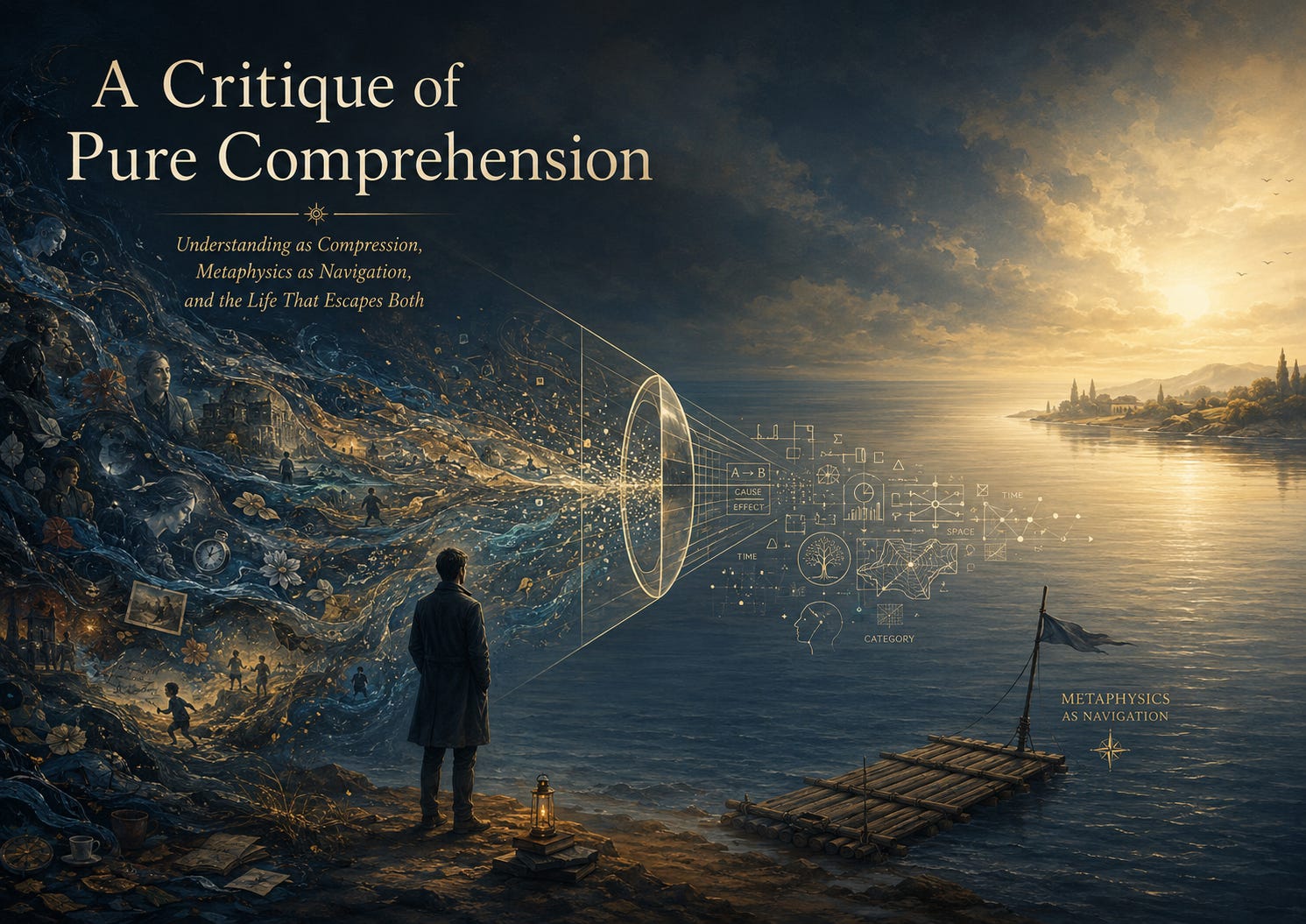
Every act of comprehension begins by throwing something away.
Critique of Pure Comprehension — Part I of II
Next in the series: The Signal Must Also Go — Part II
We do not ordinarily notice the sacrifice because what remains is useful. A bewildering event becomes a cause. A complicated person becomes a character. A decade becomes a lesson. A life becomes a story.
The reduction feels like illumination.
Perhaps it is illumination. But it is also reduction.
To comprehend something is to retain certain relations while discarding much of the resolution in which those relations originally appeared. The mind preserves what it judges to be significant: cause, pattern, identity, intention, consequence. It lets the rest fall away as accident, atmosphere, repetition, noise.
This is why understanding helps us remember. It does not always store the event as an event. It stores a structure from which a representation of the event can later be regenerated.
Rote memory tries to preserve the sentence.
Understanding preserves something like the grammar from which the sentence—and many other sentences—can be produced.
The Generative Memory
When we learn a poem by heart, successful recall is measured by fidelity. The same words must return in the same order. But when we understand an argument, exact reproduction becomes less important. We may restate it, shorten it, translate it into another vocabulary, construct a new example, or apply it to a situation the original author never encountered.
What returns is not necessarily the original text.
It is an instance of the understanding.
Reasoning therefore appears to do more than operate upon stored knowledge. It also reorganizes how knowledge is stored. It identifies dependencies, compresses multiple cases into principles, and creates several routes by which the material can be recovered.
A memorized proof can be repeated. An understood proof can be reconstructed.
This intuition has a limited but genuine resonance with contemporary models of memory. Some cognitive scientists have used lossy compression and rate-distortion theory to model why memory often preserves gist while altering detail. One influential proposal describes episodic memory as relying upon a learned generative model that retains latent structure and reconstructs an event from an incomplete trace. The proposal is a computational model, not a complete theory of mind, but it captures something important: memory can be useful precisely because it is not a perfect recording.
The same word — generative — will return later in a different register, when the model in question is not the brain's but a machine's.
What is forgotten is not always random. It is forgotten according to what the system considers costly to lose.
That qualification matters.
Compression always has a distortion function: some differences are treated as significant, others as expendable. In a technical system, that function may be mathematically specified. In a human life, it is shaped by attention, desire, fear, language, culture, identity, and purpose.
Two people may therefore compress the same event differently.
One remembers the insult. Another remembers the reconciliation. One sees betrayal; another sees immaturity. One preserves the fact that a relationship ended; another preserves the way sunlight fell across the room during the final conversation.
Neither carries the event whole.
Kant’s Tribunal
Kant called his great work a Critique of Pure Reason. But “critique” did not mean a rejection of reason. It meant an examination of its legitimacy: its sources, capacities, extent, and boundaries.
More precisely, Kant’s project concerned the possibility of metaphysics and of cognition that claims validity independently of experience. He distinguished sensibility, through which objects are given; understanding, through which they are thought by means of concepts; and reason, which seeks principles, completeness, and the unconditioned. His conclusion was not that cognition is useless, but that speculative cognition cannot legitimately extend beyond the conditions of possible experience and claim knowledge of things as they are independently of those conditions.
Kant therefore asked, in effect:
Under what conditions can reason know, and where does its authority end?
A critique of pure comprehension begins from a related but different question:
What must experience lose before it can become understandable?
This is not Kant’s question, and it should not be attributed to him. Kant examined the conditions that make experience and objective cognition possible. The present inquiry examines the transformation by which lived experience becomes an intelligible representation.
Kant asks about jurisdiction.
I am asking about resolution.
The two questions meet at one point: cognition does not merely receive a finished world and reproduce it without alteration. Kant argues that human experience requires the cooperation of what is given through sensibility and what is supplied by our cognitive faculties. He does not claim that the mind arbitrarily invents reality. He claims that what can appear as an object of human experience is already conditioned by the forms through which human cognition operates.
My extension is simpler and more existential.
Even after something has become available to experience, understanding must select what kind of thing it is.
Was it an accident, a punishment, a symptom, a lesson, a betrayal, a liberation, or merely something that happened?
The event does not arrive with one of these descriptions visibly attached to it.
Understanding attaches one.
Comprehension Is Compression
To comprehend is to gather many details under fewer relations.
A thousand encounters become a friendship. Ten difficult years become “my struggle.” Contradictory actions become a personality. An entire childhood becomes one explanation for why I am the way I am.
The explanation may be valid. But validity is not completeness.
Comprehension preserves structure by sacrificing resolution.
It removes the apparently irrelevant. It identifies invariants. It creates boundaries around what was originally continuous. It produces an object that can be recalled, discussed, compared, judged, and used.
That object is not nothing. It may be the only form in which a finite mind can carry the event forward.
But it is not the event.
Here lies the ordinary violence of biography. A life is retrospectively organized until contingency begins to resemble destiny. Every hesitation becomes preparation. Every wound becomes instruction. Every wrong turn becomes secretly necessary because it eventually led to the narrator who now explains it.
The explanation closes over the life.
The danger is not that the explanation must be false. The danger is that it becomes more memorable than what happened.
We no longer remember the person. We remember our understanding of the person.
We no longer experience the grief. We remember what the grief taught us.
We no longer inhabit the life. We inhabit its summary.
But Is Pure Experience Possible?
It is tempting, at this point, to oppose experience and understanding completely.
Experience would be immediate, whole, and innocent. Understanding would arrive later, divide it into concepts, and diminish it.
But Bhartṛhari makes this clean separation difficult.
In a celebrated verse of the Vākyapadīya, he writes:
There is no cognition in the world in which the word does not figure. All knowledge appears, as it were, intertwined with the word.
The Sanskrit uses pratyaya here in the sense of cognition or awareness and speaks of cognition as accompanied or penetrated by śabda. Bhartṛhari’s larger philosophy treats linguistic meaning holistically: the meaning of an utterance is not simply assembled from independently complete word-parts but appears as an integrated cognitive whole.
This does not license every modern claim sometimes placed upon Bhartṛhari. It does not, by itself, prove that every sensation is a consciously verbal judgment or that language creates every aspect of reality.
But it places pressure upon the fantasy of an entirely unformed human experience—an experience that first arrives in absolute purity and only afterward encounters language.
The moment something appears as something, a determination has occurred.
A sound appears as a word.
A movement appears as a threat.
A silence appears as rejection.
A bodily contraction appears as fear.
Cognition is already relational. What is present acquires significance through what is absent but remembered, anticipated, contrasted, or implied.
This is where anvaya becomes indispensable—not necessarily as one narrowly defined doctrine belonging to one school, but in its disciplined sense of connection, continuity, and relational placement. A word without connection does not yield the same meaning as a word within a sentence. An event without temporal and personal context does not become the same event for consciousness.
We do not first cognize perfectly isolated atoms and then optionally assemble them into a world.
The assembly is part of their intelligibility.
Thus experience and understanding cannot be separated as pure original and corrupt copy. The distinction is subtler.
Experience is our undergoing of the event. Understanding is our attempt to stabilize what the event was.
Formation may already be present in experience. But explanation adds another degree of compression. It turns the unstable event into an account that can travel without the event.
There may be no human experience entirely free from mediation.
There can nevertheless be experience that has not yet been forced into a final explanation.
Why Metaphysics Becomes Necessary
If cognition is always already structured, metaphysics cannot be dismissed simply as an artificial construction imposed upon an otherwise metaphysically neutral life.
We already live through assumptions concerning what is real, permanent, valuable, causal, personal, and free. Most people do not escape metaphysics. They inherit one unconsciously.
The self is assumed to be substantial.
Pleasure is assumed to be good.
Continuity is assumed to be identity.
What is measurable is assumed to be real.
What is temporary is treated as though it could provide permanent security.
A deliberate metaphysics can expose these concealed commitments. It can distinguish the permanent from the impermanent, the self from what is mistaken for the self, appearance from reality, dependence from independence, bondage from freedom.
In this sense, metaphysics is not only a speculative description of existence.
It is a navigational instrument.
It reorganizes attention.
A doctrine of impermanence changes how loss is encountered. A doctrine of dependent origination changes how agency and identity are interpreted. A doctrine of Brahman changes the status of plurality. A doctrine of eternal difference changes the meaning of relation and devotion.
These doctrines must not be collapsed into one another. Their metaphysical claims differ, sometimes radically. They do not all describe the same destination in culturally different words.
Yet they can share a practical function: each provides a structure through which the inherited world may be seen differently.
Metaphysics replaces an unconscious compression with a conscious one.
It gives the mind a better map.
The Raft’s Temptation
A better map, however, creates a subtler danger.
Because it rescued us from confusion, we begin to worship its lines.
Because a distinction dissolved one attachment, we become attached to the distinction.
Because a doctrine revealed the contingency of our former world, we treat the doctrine as a possession that must survive every crossing.
The Buddhist raft simile is exact here. In the Alagaddūpama Sutta, the teaching is compared to a raft constructed for crossing a dangerous body of water, not for being grasped and carried after its purpose has been fulfilled. The simile concerns the proper use of the teaching; it should not be inflated into the claim that all philosophical systems are identical or equally provisional in precisely the same manner.
Still, the image exposes a recurring pathology.
The tool that defeats one form of clinging becomes the object of another.
This is why metaphysics may be necessary for crossing saṃsāra and yet detrimental when converted into metaphysical ownership.
But a further temptation lurks nearby: the assumption that if metaphysics is a raft, the far shore must therefore have no place for understanding at all — as though liberation meant intellectual blankness. This inference is not required, and it is worth resisting before it hardens into doctrine.
Different traditions describe liberation differently. Some give knowledge a decisive liberating role. Some distinguish conceptual knowledge from direct realization. Some speak of wisdom, cessation, recognition, devotion, or the ending of ignorance. It would therefore be inaccurate to claim that every tradition places liberation wholly outside cognition.
The stronger and more defensible claim is this:
The opposite shore cannot be contained as an object possessed by discursive understanding.
Understanding may guide.
It may negate an error.
It may reveal a contradiction.
It may prevent us from mistaking the conditioned for the unconditioned.
It may even be described, within certain traditions, as indispensable to liberation.
But the representation of freedom is not freedom.
The concept of non-attachment may itself be held with attachment.
The explanation of silence remains speech.
The map of the shore remains on this shore.
A Critique of Pure Comprehension
A critique of pure comprehension would therefore examine not whether understanding is possible, but what authority its products deserve.
Its first proposition would be:
Comprehension forms its object.
It does not necessarily fabricate the object, but it selects, relates, names, and bounds what will count as the intelligible object.
Its second proposition would be:
Every comprehension has a distortion function.
Something is preserved and something is discarded. The decisive question is not merely whether compression occurs, but who or what determines which losses are acceptable.
Its third proposition would be:
There is no readily available human standpoint of total non-compression.
Language, memory, expectation, embodiment, and relation participate in cognition. “Life as it is” cannot simply mean life as viewed from nowhere.
Its fourth proposition would be:
Metaphysics is unavoidable as orientation but dangerous as possession.
We require structures to discover the inadequacy of our inherited structures. Yet every liberating structure can harden into another enclosure.
Its final proposition would be:
Wisdom is not maximal comprehension.
It is not the compression of the whole universe into one final explanation.
It may instead be the capacity to use understanding without requiring reality to fit completely inside it.
The Machine Returns
This brings us to the language model.
A language model does not ordinarily retrieve an intact passage from an internal library. It produces a continuation from patterns distributed across its parameters and activated by the present context. The output may preserve a relation, style, or semantic structure without reproducing an original source.
The analogy with human understanding is useful but limited.
Both can generate fresh instances rather than exact copies. Both can preserve structure while losing provenance and detail. Both can produce fluent reconstructions that feel like recollection.
But this functional similarity does not settle whether machines understand in the same sense as embodied human beings, whether they are conscious, or whether human cognition is exhausted by computational description.
The more immediate lesson is epistemic.
Generation can masquerade as memory.
Representation can masquerade as presence.
Understanding can masquerade as life.
What the Critique Leaves Behind
Kant summoned pure reason before reason’s own tribunal.
A critique of pure comprehension must now ask understanding to submit its accounts.
What did you preserve?
What did you discard?
Why was this detail classified as noise?
Whose desire selected the pattern?
Whose fear supplied the explanation?
What became invisible when the life was converted into a lesson?
We cannot live entirely without comprehension. Without compression, every moment would arrive with unbearable and unusable abundance. We could neither remember nor communicate, neither generalize nor navigate.
Understanding is one of the ways a finite being survives the infinite resolution of existence.
But survival is not sovereignty.
Understanding may carry us across confusion. Metaphysics may orient the crossing. Reason may tell us which rafts leak and which circles return us to the shore we meant to leave.
Yet the final dignity of understanding may lie in recognizing that it cannot carry everything.
Comprehension is compression.
Wisdom begins when compression remembers what it has lost.
References and further reading
Immanuel Kant — https://plato.stanford.edu/entries/kant/
Bhartṛhari — https://iep.utm.edu/bhartrihari/
Alagaddūpama Sutta (MN 22), The Simile of the Raft — https://suttacentral.net/mn22/en/bodhi